Economy, Inequality and the Earth
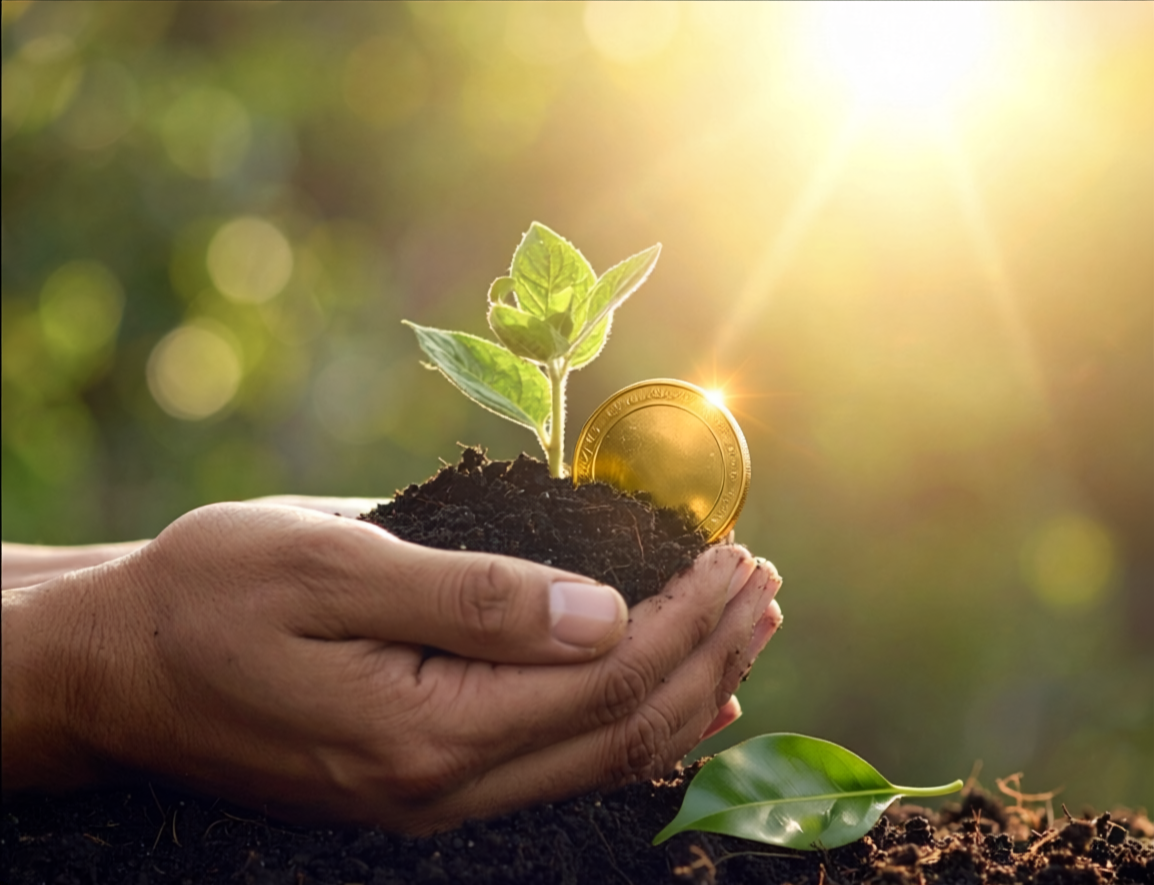
Hands holding earth, metal (money) and a leaf - all connected.
Last night, myself and my two teenage children watched Gary Stevenson's documentary on Channel 4. Myself and my youngest daughter really like Gary's viewpoint — his compassion and his broader understanding of how economics relates to inequality.
The story behind the argument
Last night, myself and my two teenage children watched Gary Stevenson's documentary on Channel 4. Myself and my youngest daughter really like Gary's viewpoint — his compassion and his broader understanding of how economics relates to inequality.
One thing I think is super important to remember about Gary is his own personal journey — what he's seen and experienced, the people he talks to, and the wider landscape he's moving in.
He's in alignment with the Green Party, Novara Media and Owen Jones — all people and platforms I follow myself (links below). I mention them because they illustrate a pattern I notice: the further someone leans toward sustainability and environmentalism, the more likely they are to view Gary's argument favourably. The wealthy, self-interested men in the documentary, who showed little care for anyone beyond themselves, were never going to agree with any of his ideas — the film illustrated that clearly. That's not a coincidence. It's the same worldview showing up twice, once toward people and once toward the planet.
Of course, that alignment also means his storytelling can seem one-dimensional at times — tax the super-rich 2% over £10 million, as a rule. But that's because he connects to people first. He listens, observes, and seeks to understand the wider issues in this country and others before forming a view. That shapes his opinions strongly.
If you're talking to the general public about a complicated economic, political and historical situation — one that also carries sociology, psychology and creative dimensions — you can hardly do that justice in 60 seconds. But people can understand inequality, the same way they understand prejudice, racism, or sexism. If he's getting wide coverage and people are talking about his views, then to him that's good press. And rightly so.
What the documentary showed me
The documentary was horrendous in the sense that the wealthy men interviewed all wanted to protect their own wealth (and/or their clients') and didn't care too much about everyone else. As far as they were concerned, it's everyone for themselves, and if you happen to be exceptionally wealthy, then good for you. End of.
If you were born in a deprived area, had any lived experience of poverty — then tough. Work hard and do better.
What these people showed no understanding of is how many businesses go under every year. How many people try hard for years, even decades, and don't become millionaires. How many people have very high work ethics but then something happens outside their control and things collapse. Life isn't a simple equation of grow up, work hard, make tons of money, die. If only it were.
It was touching to see Gary's emotional response to the doctor who came out of the hospital, shivering with cold, listing the exorbitant cuts to healthcare. Why aren't more people unhappy about that? We should be.
There was only one woman interviewed with wealth — and what a surprise that she cared about others, her country, and wanted to see the UK thriving. That's the big take-away. The one guy who said he'd quit the UK — take a loss hit — just so he didn't have to contribute more to services, was awful.
I'm deliberately taking the human view here, because it's as important as the financial one.
Where the leverage actually sits
This is where I keep coming back to something I look for in any system I work with, whether that's a person, a team, or a country: where does the real leverage sit, not just where the activity is.
A few facts worth sitting with:
In the UK, the top fifth of the population hold 63% of the country's wealth, while the bottom fifth hold just 0.5% (Equality Trust, 2025).
The richest 56 people in the UK now hold more wealth than 27 million people combined (Oxfam GB, 2026).
A 2% tax on wealth over £10 million — the rule Gary talks about — could raise an estimated £24 billion a year (Oxfam GB, 2026).
UK income inequality, measured by the Gini coefficient, stood at 33% before housing costs and 37% after in 2024/25, among the highest in Europe (Francis-Devine, 2026).
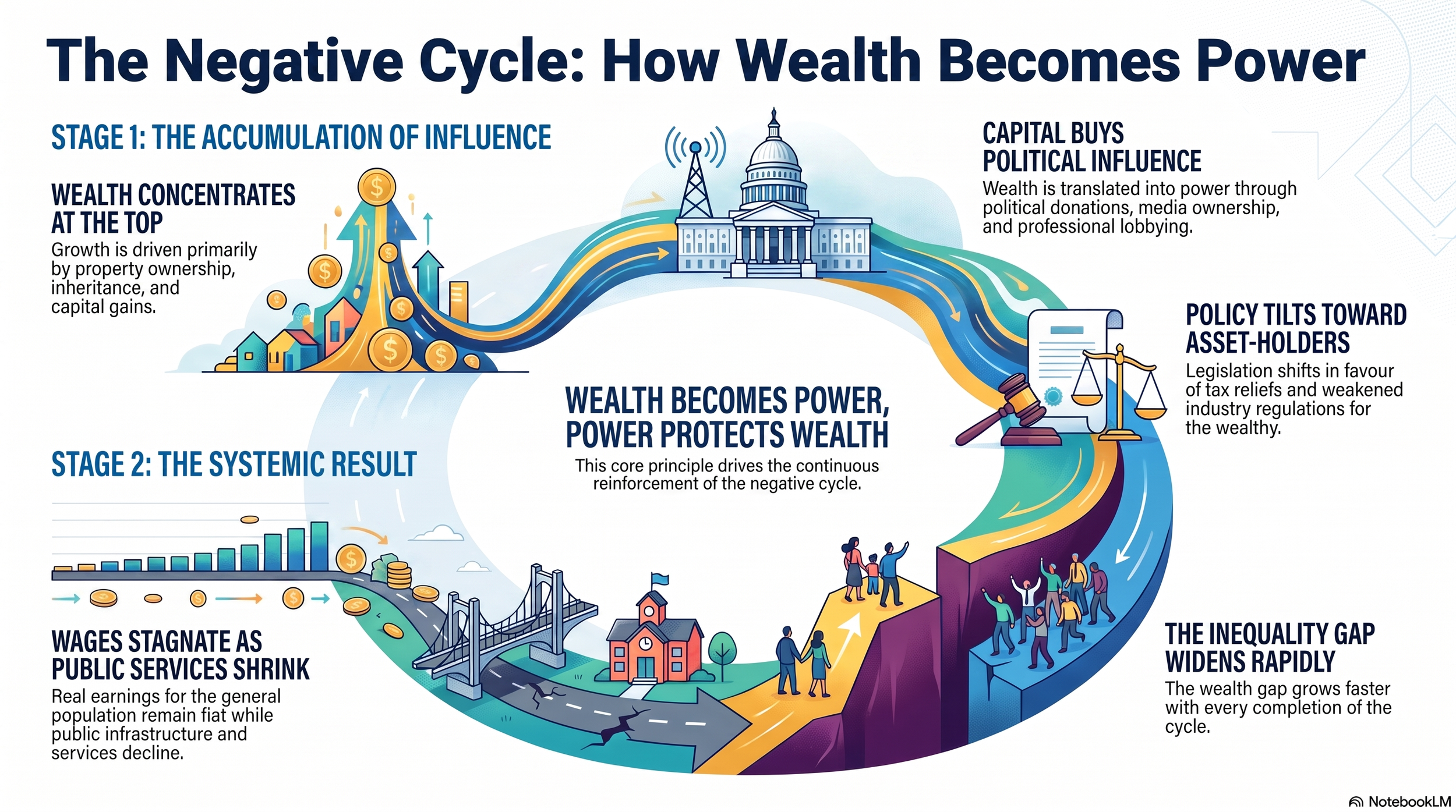
A brief example of how extreme wealth influences power and outcomes for everyone
Numbers like these confirm what the documentary showed emotionally: this isn't a story about a few bad individuals. It's a system that keeps concentrating power at the top, and then normalises the belief that protecting your own position is not just acceptable, but sensible.
Surely a peaceful, happy, healthy, productive world is better than one consistently paying out for violence, war, emergency relief, disasters, poverty and famine? It's insane to me that so many people are that ego-centric, that self-focused. I'm not saying Gary's idea is a cure-all. But human issues are more than money — money is a big reason they persist where they do. War is money. Power is money. Control is money.
Equality, therefore, is about a more level, kinder and fairer playing field for all — not just the super-rich. Especially when you bear in mind that some inherit wealth, some get lucky, and some get it through a variety of not-good ways. Yes, some people build wealth the ethical way — but they're not the problem. They're most likely already giving to causes.
Why this doesn't stop at people
It's the ones who don't want to make a substantial difference to the survival of our planet and all its beings — humans and animals — that you have to worry about.
This is the part I think gets missed most often in conversations about inequality. The same entitled thinking that says "I only need to consider my own position" doesn't stop at other people — it extends to whoever, or whatever, has the least power to push back. Historically that's been the poor, the sick, the disenfranchised. Today it's also the animals in industrial farming systems and the ecosystems being extracted for short-term gain. It's what's sometimes called the expansion of our moral circle — who we consider worth caring about — and right now, that circle is still far too small.
Inequality is a humanity problem. Wealth inequality is an individual's humanity problem. It's a sweeping statement, but the facts remain: if you're part of this world, care about it, and want it to stay the beautiful, abundant, creative place it is, then hoarding money, chasing a place on the super-rich list, or measuring your worth by monetary success alone, isn't the way to do it.
Feeling entitled to consider only your own position — and maybe your stakeholders' — has been a recipe for disaster. History shows us that violence, greed, and the pursuit of control and power have never led any individual to a place of peace.
Conversations aren't actions
My only issue with conversations is that they aren't actions. It's good to communicate, share ideas, and innovate — but the only way out of global inequality is starting somewhere and taking some action. We might get some things wrong, or better ideas might come along, but it's important not to stand still, watch, and do nothing.
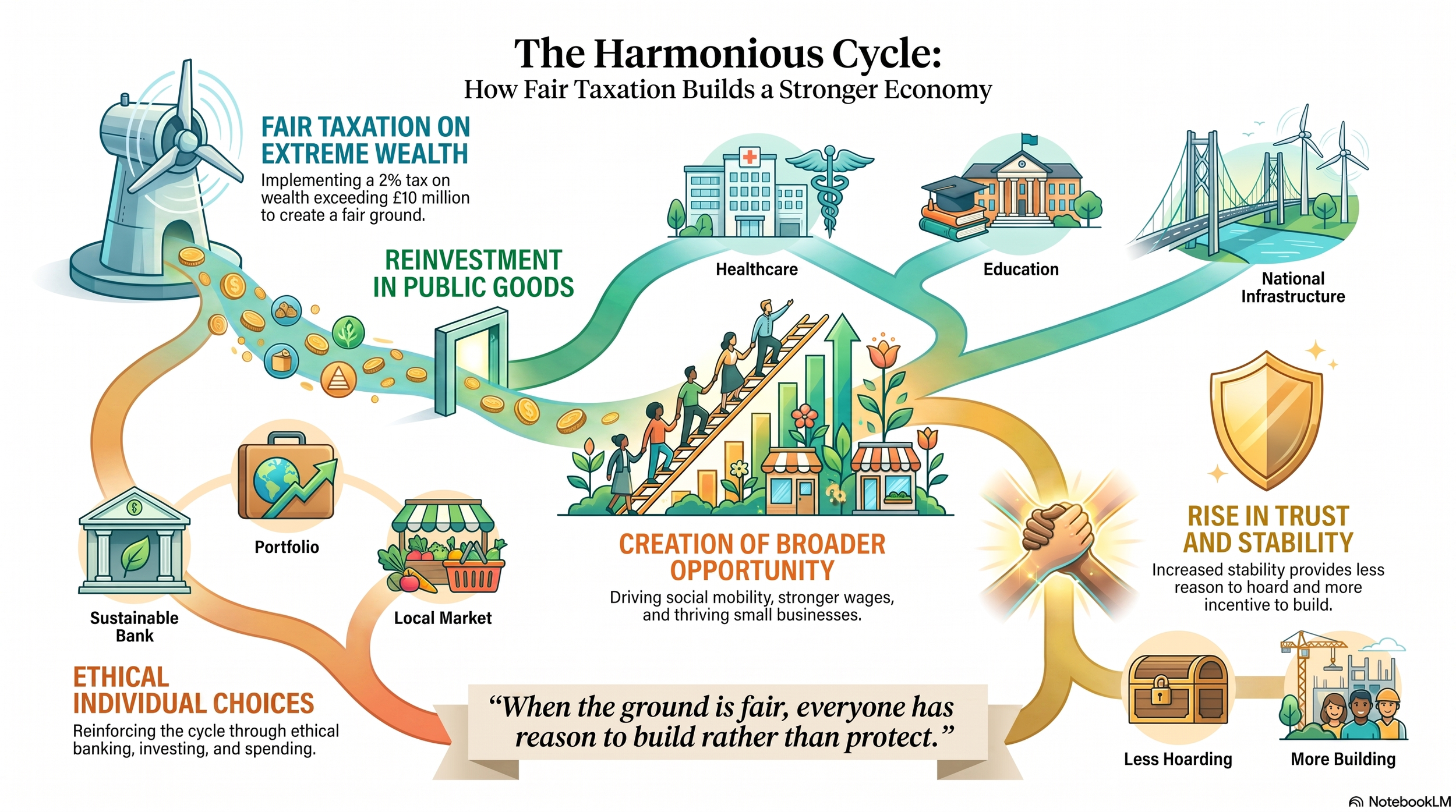
Using Gary Stevenson’s example of a 2% tax on wealth over £10 million - to illustrate how it would increase equality, ethics and sustainability for all.
Easy actions:
Where you bank — not supporting corruption, war, etc.
Where you shop — what are their politics, whom do they fund
Who you support — what are they doing with your money, energy, support
What you eat — is it plant-based
What you wear — how it's made, from what, and where
Where you invest — are they ethical
Where you donate — which funds are doing great things out there
...and anything else you can add to the list.
Personally, I think Gary did a good job highlighting a good group of key areas. Whether or not you agree with every conclusion he draws, the questions he's raising are the right ones to be sitting with.
I also feel, that the interconnectedness is very important. Talking about economics, money, power and control are not separate topics. Everything exists next to something else. Send the dominoes down the way and we know what the outcome will be.
Annette
References
Equality Trust (2025) The Scale of Economic Inequality in the UK. Available at: https://equalitytrust.org.uk/scale-economic-inequality-uk/ (Accessed: 14 July 2026).
Francis-Devine, B. (2026) Income Inequality in the UK. House of Commons Library Research Briefing, CBP-7484. London: House of Commons Library. Available at: https://researchbriefings.files.parliament.uk/documents/CBP-7484/CBP-7484.pdf (Accessed: 14 July 2026).
Oxfam GB (2026) Resisting the Rule of the Rich: Protecting Freedom from Billionaire Power. Oxford: Oxfam. Available at: https://www.oxfam.org.uk/get-involved/campaign-with-oxfam/fight-inequality/oxfams-global-inequality-report/ (Accessed: 14 July 2026).
Further reading
Owen Jones — https://www.owenjones.news/
Novara Media — https://novaramedia.com/
The Green Party — https://greenparty.org.uk/
#Inequality #GaryStevenson #SystemsThinking #ConsciousLeadership #Sustainability
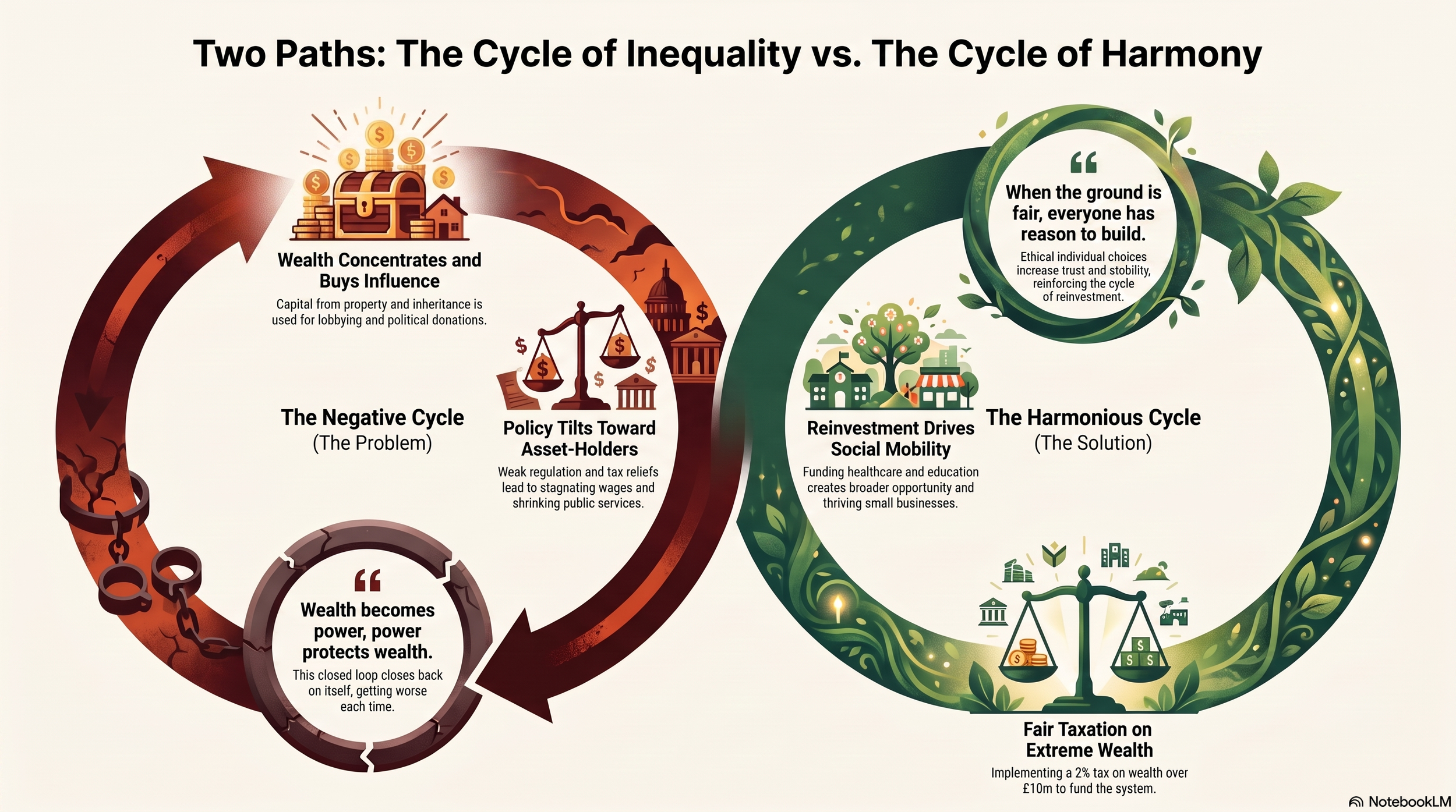
A simple illustration of a negative cycle and a positive one. Whilst the topic is not simple. We can make simple and steadfast choices to make sure we are in harmony not inequality and all that follows it for the earth and all inhabitants.
